Lyndacom the Art of Color Correction Color Grading for Locations and Times of Day
Due west east've all seen films with an eerie green or chilly blueish tint that drives home the tone of the project. These different atmospheres, and many more, stand every bit monuments to the film and video coloring procedure. Information technology takes a proficient corporeality of inquiry and do to command images with advanced precision. What'southward the difference between color grading vs. color correcting? And what other color processes tin can filmmakers use to tell their stories?
In this postal service, we're going to take you lot through the process of coloring digital video and so that you can control the mood of your projection. You'll be ready to institute your unique video style, or go footage that resembles your favorite films and shows.
Tabular array of Contents
Everything y'all need to know about color grading and color correction
- Color Process Nuts
- Video Color Intro
- Understand Colour Hue
- Grasp Color Saturation
- Larn Colour Effulgence
- Study Coloring Tools
- Color Procedure Steps
- Determine Picture Profile
- Colour Correct
- Colour Grade
- Video Colour Examples
- Flick Profile Examples
- Color Correction Examples
- Colour Grade Examples
- Color Palette Examples
1
Color Procedure basics
what Y'all Demand TO KNOW about video color
1.1 VIDEO COLOR intro
The basics of digital video color
The procedure of properly coloring your footage is made up of three main interconnected tasks. Similar whatsoever other recipe or formula, it is a general rule to do each of these tasks in their proper order, stride by footstep.
Digital video coloring steps:
- Establish motion-picture show contour
- Color right footage
- Color form footage
These steps come up with their own sets of micro-tasks, and with their own specific orders. Before we go on, let's quickly break downward our ii "championship processes" of color grading and color correction to keep anybody on the aforementioned page.
COLOR GRADING VS. COLOR CORRECTION
Color correction is a technical procedure that fixes color problems and makes footage announced equally naturalistic equally possible. The idea is for colors to look make clean and real, as human eyes would meet them in the real world.
Color grading is likewise technical, but information technology'south more of a creative business concern. The color grading process adds atmosphere and emotion to shots by coloring footage in new, often unnatural ways.
The issue of a finished video or motion picture comes from a combination of both color grading and colour correction — and then information technology'due south non actually a matter of 1 "versus" the other. Rather, it'due south all about the way they are combined to generate a desired expect.
It'southward the difference between "add ii eggs" and "crack 2 eggs into a bowl, whisk them for thirty seconds, and so arctic in the refrigerator for an 60 minutes."
We'll leap into the steps shortly, but outset we need to become over some basic color terms that volition be used no affair which color grading software or camera y'all use.
i.2 VIDEO Color ESSENTIALS
What is color hue?
Hue refers to the color itself. In simplest terms, it's the difference between red and blue. Your hue can then be altered by saturation and brightness, which nosotros'll cover as soon as we give y'all a few paragraphs on hue.
Together, hue, saturation, and effulgence are known equally "HSB." This combination makes up the bones colour concerns of any video prototype.
Hues don't always have to be vivid, master colors.
A pare tone, for case, might be a brown hue that has very piddling saturation, and a lot of effulgence — giving the states a "fair" skin tone.
That same hue can be saturated and darkened to give us a different skin tone, all while still corresponding with the brownish hue. Some skin tones will take different jumping off hues, so use your spot sampler to identify.
Here'southward a video that breaks downwardly HSB color theory, and gives a good primer for our discussion of color grading and color correction.
Hue, saturation, and brightness (HSB) explained
Color schemes need to be your concern. Main filmmakers care for color equally a creative component as as of import as the script, the talent, and the camera shots.
In the video above, you lot can meet how hue, saturation, and effulgence color theory (HSB) can exist practical to create mood in any picture show or video.
one.three Colour grading video
What is color saturation?
Saturation refers to the intensity of the colour. This is determined past the amount of grey in the hue, from pure grey, to a vivid color.
Saturation is where you really get to make your colors "pop," or, at the other finish of the spectrum, become "muddy." Believe information technology or not, this is all due to the amount of grey information in the colour. Seems simple, correct?
If you add pure white or pure black to your colour, you'll get a darker or lighter brightness value, which is our side by side category.
i.four VIDEO Color correction
What is color effulgence?
Brightness refers to the level of light in your color. This determines the divergence between, say, burgundy and processed apple tree.
The hue for each is still cherry, and the saturation is at the max for each, but the amount of white and black in the color value is different. A colour with intense saturation that has a high brightness value might make the viewer feel energetic and happy, whereas the aforementioned hue with a high saturation and low brightness value may evoke dread.
Is blood creepier when it is bright or when information technology is dark?
Those are fun questions that can come up during pre-product, and be emphasized and seized upon during the coloring process.
one.5 color grading software
Which coloring tools should I use?
At that place are a number of coloring tools and effects that can be applied, and altered, to help y'all both right and grade your footage. Adobe Premiere is a good place to starting time:
Coloring tutorial with Adobe Premiere
Different programs do things improve than others. Adobe Premiere, for case, is a non-linear editing (NLE) platform that include a robust menu of color tools.
DaVinci Resolve is an example of a more specialized, stand-alone color plan, which too includes editing features.
We don't want to play favorites, then here'southward a good overview of DaVinci Resolve likewise:
Coloring tutorial with DaVinci Resolve
Let'southward pause downward these tools a bit farther, just retrieve …
Don't brainstorm coloring your footage until you've read through the entire article because color is complex, and if yous rush ahead you could destroy paradigm quality and leave production value on the table.
1. White Balance
White residuum is the same affair in your camera every bit it will be in coloring programs. It describes the color temperature of your image.
If you properly white residue your camera for the scene, you should have images that keep your colors around their intended values. Even if you do this in camera, you'll likely need to make a few necessary tweaks in mail to get you domicile.
Your white remainder should exist 1 of the first things you lot practise, because it will affect every single decision you brand from there on out.
two. Scopes
You will want to utilise scopes (Waveform, Parade, Histogram, Vectroscope) to give you lot some extra value color info that y'all didn't see initially.
Check out this video to run across a demonstration of scopes.
How to understand scopes
Equally you can run across, scopes are a simple but powerful tool that let you to properly color correct your footage.
Scopes are a monitoring tool that show color and light information on a graph and then that you tin can come across the precise residue of these characteristics and how they compare to one some other.
3. Curves
Curves are helpful for precise color correction and colour grading, and you will desire to pair these with your scopes.
With curves, you can add points to elevate colors to new values, and change shadows, midtones, and highlights with much more precision.
When yous make a curves adjustment, you command the entire colour aqueduct shift with any movement of the drag points. And that'south a good matter, because it means the change isn't isolated, simply interconnected.
This generates gradual changes rather than big farthermost changes. You can always zoom in and add another elevate bespeak to brand a small adjustment.
iv. Color Friction match
Color match allows yous to choose a reference paradigm that will and then be analyzed and applied to your target image.
This is an automatic adding, so it is of import to bank check your scopes and use your sentence every bit to the quality of the color match.
Some people fifty-fifty like to use popular film clips as their reference prototype, and their own personal footage equally the target image.
This is fine for your color form, merely don't do this to color correct. If you practice, it will completely throw off the value of your colors and ultimately brand your life a lot harder than information technology needs to be.
Color lucifer, equally demonstrated in Adobe Premiere
The best way to use color match is after you've color corrected some footage and at present demand to utilize those same corrections to a target clip.
Frequently, you lot could but copy and paste the effects from your previous clip onto an adjustment layer, or through the use of bins, just if your footage has lighting and exposure discrepancies, it may not work very well.
5. Three-Mode Corrector
Three-way colour correctors are a useful tool for many colorists in professional entertainment, only they have their pros and cons.
The three-way colour corrector lets you residual the shadows, midtones, and highlights of an epitome using color wheels. You can set numerical values, or use the control elevate indicate to set your value based on hue.
7. Color Qualifiers
Color qualifiers requite you the chance to change a particular color, or range of colors, without changing the rest of the flick.
You tin also use color qualifiers to identify colors that you desire to fix in place and so that they won't change when y'all adjust other colors and elements in the picture.
8. Color Masks
In the DaVinci program, color masks are called Power Windows. These piece of work a lot like masks in Adobe Photoshop. You can designate a shape to isolate its colors.
2
Color Process Steps
HOW TO PROPERLY COLOR FOOTAGE
2.1 VIDEO Color Process
How to pick your picture profile
First things get-go. Choose your movie profile.
If you are shooting in RAW format, you lot will have a large corporeality of control over the characteristics of your image. Across general quality, this is 1 of the attractive advantages of RAW, but it eats up a lot of storage (This is because RAW images, captured unprocessed by the camera with no gear up parameters, are uncompressed).
If y'all are not working in RAW, chances are that you lot volition desire to record in a flat pic profile, or Log profile, to give yourself more opportunities when it comes to coloring and enhancing your footage.
Color SPACE DEFINITION
What is a moving picture profile?
A moving picture profile refers to a set of parameters that decide the characteristics of your footage. Popular picture profiles for professional person video are 'C-Log' (Canon) or 'S-Log' (Sony), only there are many others.
What does a picture profile practise?
- Establishes baked-in parameters for your footage.
- Specific profiles give yous a more obedient epitome.
- Maintains consistency across your footage.
Meet how important it is to establish color profile starting time?
You can't get back on your flick contour because information technology is baked into your footage (unless yous're capturing images in RAW).
Your picture profile can be whatever you want it to be, but mostly if it is more "flat" it volition requite you the best chance to pull out some actress steps of dynamic range, and keep your footage out of trouble.
This is where y'all hear the term "Log," and more than specifically "C-Log" (Catechism) or "S-Log" (Sony). These are substantially neutral picture profiles (but non RAW!), giving you the all-time chance for controllable images.
2.2 color correction guide
How to color correct video
Now we tin can begin to color correct.
Color correction methods take changed since entertainment product switched to digital footage, just it is still just as important for professional person images. You've established your picture show profile, and then at present let'southward talk about i of the most important steps in any post product workflow.
COLOR CORRECTION DEFINITION
What is colour correction?
Color correction refers to adjusting white and black levels, exposure, dissimilarity, and white residual to give yous an image with accurate, unprocessed-seeming colors. The point of color correction is to ensure that subsequent colour adjustments take more precision, and don't yield unintended results.
The other purpose of color correction is to create visual consistency for your footage and scenes. You lot desire them to friction match for ameliorate flow.
What does color correction do?
- Establishes truthful levels and colors.
- Allows for accurate and effective adjustments.
- Creates visual consistency throughout scenes.
If your white isn't really true white, merely rather more of a beige, any adjustment y'all make to your image will be incorrect. If you go rogue, something that looks expert to yous may look odd to someone else.
It'due south like trying to write a bully song with an out-of-tune guitar.
Color correction eliminates visual inconsistencies. You'll need to go through this process if you hope to cutting together footage that may not look exactly the same, just needs to be in the used in the same scene.
Bank check out this Adobe Premiere color correction tutorial:
Color Correction in Adobe Premiere Pro
If your color profile is flat, desaturated, and has less dissimilarity, it will allow these additions to have a more positive outcome, and give yous a flake more than control when coloring your footage.
It also helps you to clasp out some extra information in between your maximum and minimum values.
Think how piece of cake information technology would be to color the art at the museum if it was apartment, desaturated, and had less contrast. They'd be more like coloring books.
Let'south go into the micro-steps of colour correction.
one. Employ your input LUT
The LUT (which stands for look up table) that you apply in this case will shift the colors in your footage to the standard values of Hard disk broadcast goggle box, and nosotros referred to it every bit an "Input LUT."
This means that nosotros intend to ship our footage through this predetermined adjustment and so that we may accurately adjust colors during our correction and grade stage, but …
You output LUT (if you choose to apply i) is intended to achieve a cinematic look, or sometimes a "movie" look.
The Rec. 709 LUT will make your color correction sliders, curves, and scopes all work the fashion they should and then that you tin can become the most out of your creative LUTs later on.
What's the difference betwixt a Log LUT and a Rec. 709 LUT? Cheque out this video for a quick primer.
Log vs. Rec. 709 explained
Hither's a fun (and odd) metaphor.
When you brand coffee in the morning, you pour hot water over basis up beans to go … coffee!
You don't, however, pour java over basis upwards beans to get coffee.
Log footage is your hot h2o, and the coffee beans are your input LUT.
Don't put already "brewed" footage with harsh characteristics through an input LUT because you'll end upwards pushing values to farthermost levels.
Rec. 709 allows you to work from a place of accuracy, but it is not necessarily going to give you the wait yous promise to achieve, and that's where boosted LUTs and color grades come into play.
Watch this quick study in color grading with a variety of footage types:
Colour grading a variety of footage in Adobe Premiere: RAW, Log, and Rec. 709
Applying a LUT is too an opportunity to white balance your footage, either via the Machine White Balance or manual temperature adjustments.
Your photographic camera should have been white balanced before hand, but there are some picture profiles that slightly push button the colour temperature one way or some other, so you'll want to rebalance regardless.
Don't use whatever tint at this point. Not even so. You just want to get as close to true white as y'all tin and then that each footstep works correctly. Unless your footage was shot in a way that the tint helps, chances are you should avert it birthday.
two. Choose a "home base" clip
The best way to attain visual consistency across a bunch of footage is to wait at your clips and to find 1 that has average exposure and levels when compared to the remainder of your footage.
That mode, you tin effort to lucifer everything to a place that is, at the very to the lowest degree, able to be accomplished with all of your footage.
If you pick a prune that has an extreme exposure when compared to the other footage you got on the twenty-four hours, you lot may not be able to adapt those clips to match one another, thus eliminating options from your cut.
three. Adjusts white and blackness
You lot'll want to utilise your scopes hither, and yous need to do each one at a time. Conform the colors and levels to discovertrue black ortruthful white.Brand your video look properly adjusted for white and black using whatsoever number of tools. Here's how to practise it with Adobe Premiere's Lumetri Color tool:
How to go a cinematic look
Your scopes will let you know if you've gone too high or too low with your levels, and yous may need to conform your RGB curves as well.
Use the scopes for precision.
iv. Accommodate overall gamma
This is where y'all adjust each section of your image, which includes the highlights, shadows, and midtones. Again, at this point nosotros are still in the color correction phase and not stylizing or grading phase.
Remenber with gamma adjustments and color correction in general, you are Not trying to make your prototype wait "cool" or "how you lot want information technology to look" merely rather "correct" in terms of color fidelity and the relationship between each level's low-cal intensity in the image.
Video gamma explained
Later on, when nosotros get to color grading, yous can crush your blacks and blow out the whites, just during this stage you lot but want to make them coordinate with one another.
5. Bones secondary correction
In chief color correction, y'all adjust and right the entire prototype. Secondary color correction involves isolating specific parts of the image, or objects inside the video frame, and correcting only those.
The same way we've created archetypes for characters, then it goes for color schemes and colour identification of objects and imagery.
We all know that the sky is blueish, or that a stop sign is blood-red.
These are colors that anybody knows, and will look to register if say … yous take a stop sign in your footage.
If the colour of your terminate signlooks weird, that means two things:
- Your color correction is probably off by a bit.
- Viewers volition subconsciously question your story.
This means that skin tones need to look like real skin tones, blades of grass need to look similar blades of grass, and the world has to announced existent.
This video explains it well:
Secondary color correction in Adobe Premiere PRO CC
That way, when y'all exercise adjust something afterward you can be sure that it works correctly so that you achieve your intended await.
Your imagery also feeds the willing pause of disbelief and so crucial in narrative filmmaking, all because you followed the "rules."
six. Advanced secondary correction
This is where you begin to accommodate specific colors toward your desire, while still keeping in mind that they all the same demand to exist "correct."
You might want to boost the yellow of a bright-yellow sports car. You're not altering the overall xanthous in the total image, just rather boosting a very narrow hue to make specific imagery — the yellowish car — pop.
Advanced secondary color correction
We yet desire things to look the mode they should, but yous can begin to use your taste a little more during this department.
Only know that you may bump values afterward in your color grade, so do and so appropriately to avert backtrack.
Looking good? Everything's correct? Great. At present let's make the course.
ii.3 digital color grading
How to color grade video
When you begin color grading, you will of class need to start with some software. This can exist an NLE (not-linear editor) like Adobe Premiere or information technology tin be a program created specifically for color command like DaVinci Resolve.
It'due south also likely you lot'll be using the same platform to colour grade as y'all used for your color correcting — merely many video color correction and colour grading pros similar to utilize unlike software for each procedure.
Color GRADING DEFINITION
What is color grading?
Color grading refers to the stylized color scheme of your footage. This can be super extreme like you come across with many popular films, or information technology tin be rather subtle and then as to achieve color fidelity like with nature documentaries.
What does a color course do?
- Stylizes the color scheme of your footage.
- Evokes specific emotions from your viewer.
- Transforms footage for the terminal look.
Every piece of footage that has ever been recorded has a color grade, regardless of any adjustments that might be applied.
This is different from color correction, considering clips that aren't adjusted to the correct levels are Non colour corrected, but any footage you lot capture has a color grade — and it is your chore to suit that grade to display your desired expect.
It'south what turns film and video makers into artists.
Take a look at director Denis Villeneuve's color schemes in this video:
How to use color like director Denis Villeneuve
Your color form is where your footage begins to wait stylized, but it won't look the way y'all want unless you follow the outset ii steps correctly.
This is where you get to make your own creative decisions.
Using the same tools you've used to color correct, now yous can add another layer, and paint your masterpiece.
This is the moment where nosotros accept to explain that the process of coloring video is condiment.
That means nosotros are adding color information to something that already has broiled in colour values. We are not irresolute the digital values of colour, but rather adding values on top of the existing values.
It is like to going to a museum with some paint, and adding more color to art on the walls.
Yous can also enable a creative LUT to your color corrected footage, which volition apply your entire color grade literally with a single click.
In our mail service on LUTs, we become over different kinds of LUTs and give you a gratuitous pack of Ridley Scott LUTs.
Cheque out how Ridley Scott uses color here:
Mastering the movie colour palette of Ridley Scott
You tin can see right away how these creative output LUTs make your life much easier, and if you lot create your own custom color form you can export information technology as an consign LUT, and apply it to the rest of your scene.
Colour grading is something professionals consider earlier they stride on gear up. While at that place is a bit of creative latitude in post-production, you'll want to determine a starting point for your color form during pre-pro.
3
Video Color Examples
THE Before AND Afterward OF VIDEO Colour
3.i VIDEO Color Profiles
Color Profile Examples
Beneath is a clip of some footage shot in "C-Log." Yous'll exist able to meet exactly what footage should look like coming out of the camera.
Video color in exam footage
If you're working with a camera that doesn't have a Log setting, you can find your "Neutral" contour and decrease the contrast and saturation levels thus creating a custom picture profile that resembles Log.
three.2 colour correction post product
Color Correction Examples
Showing you properly color corrected images will give you a clear thought how footage is transformed before setting out to color course.
Colour management is the key to matching colors from multiple cameras
The color correction examples in the video above were shot in a flat picture show profile, run through the Rec. 709, and then corrected based on those values.
3.three VIDEO and pic color grading
Color Grade Examples
Hither are some great examples of professional person colour grades.
In the first instance, from Black Hawk Downwards, the blue is much more saturated and the brightness is definitely turned down, with the highlights lowered besides. This is a great expect for sci-fi footage, or even a nice David Fincher noir vibe.
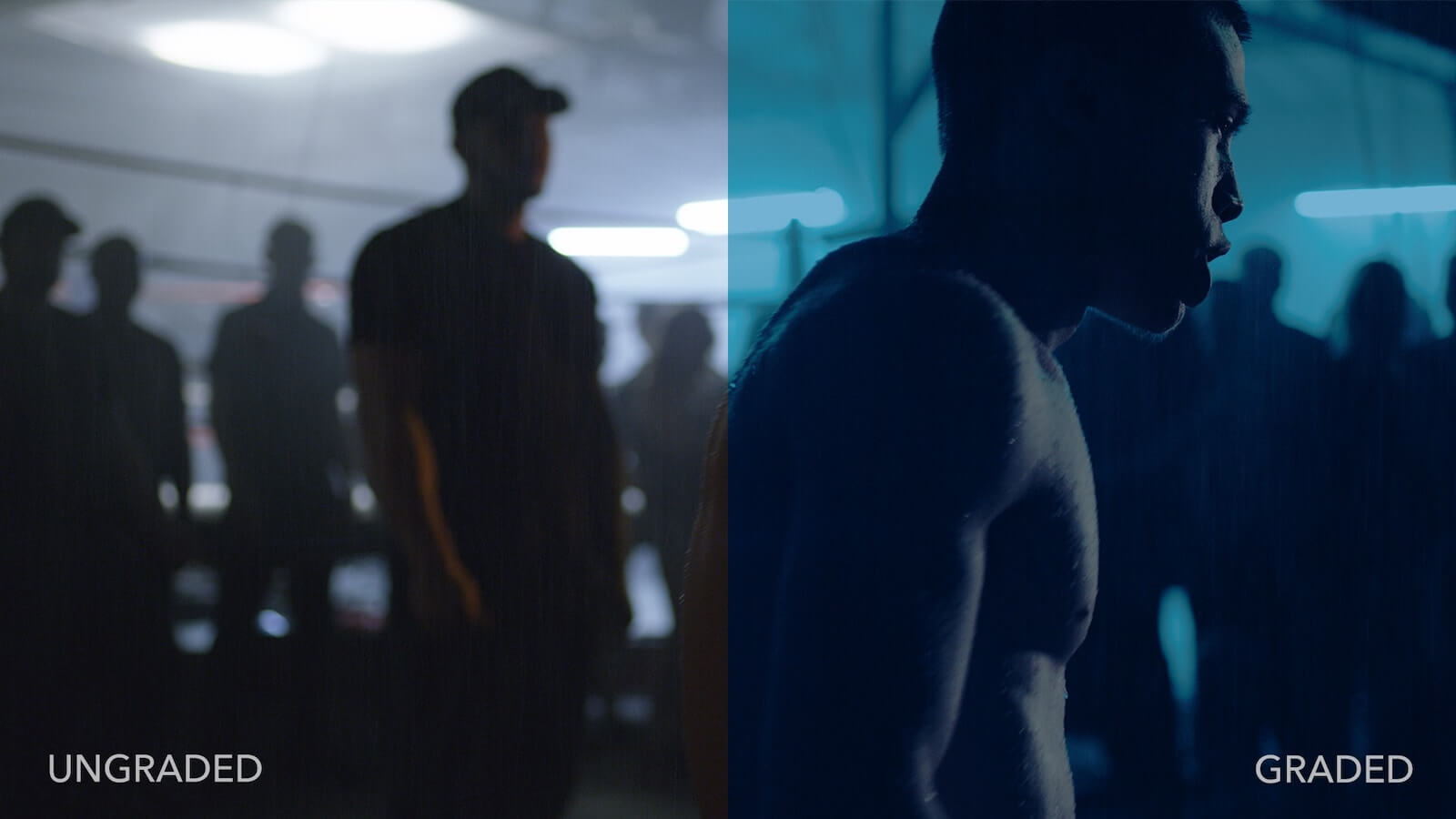
Black Hawk Downward LUT in full effect
In the next example, below, we go a landscape shot. This also comes from a Ridley Scott film, The Martian.
You'll notice immediately how much darker the sand in the ungraded clip looks, and obviously the corporeality of saturation in the sky. It looks like, well, Mars.
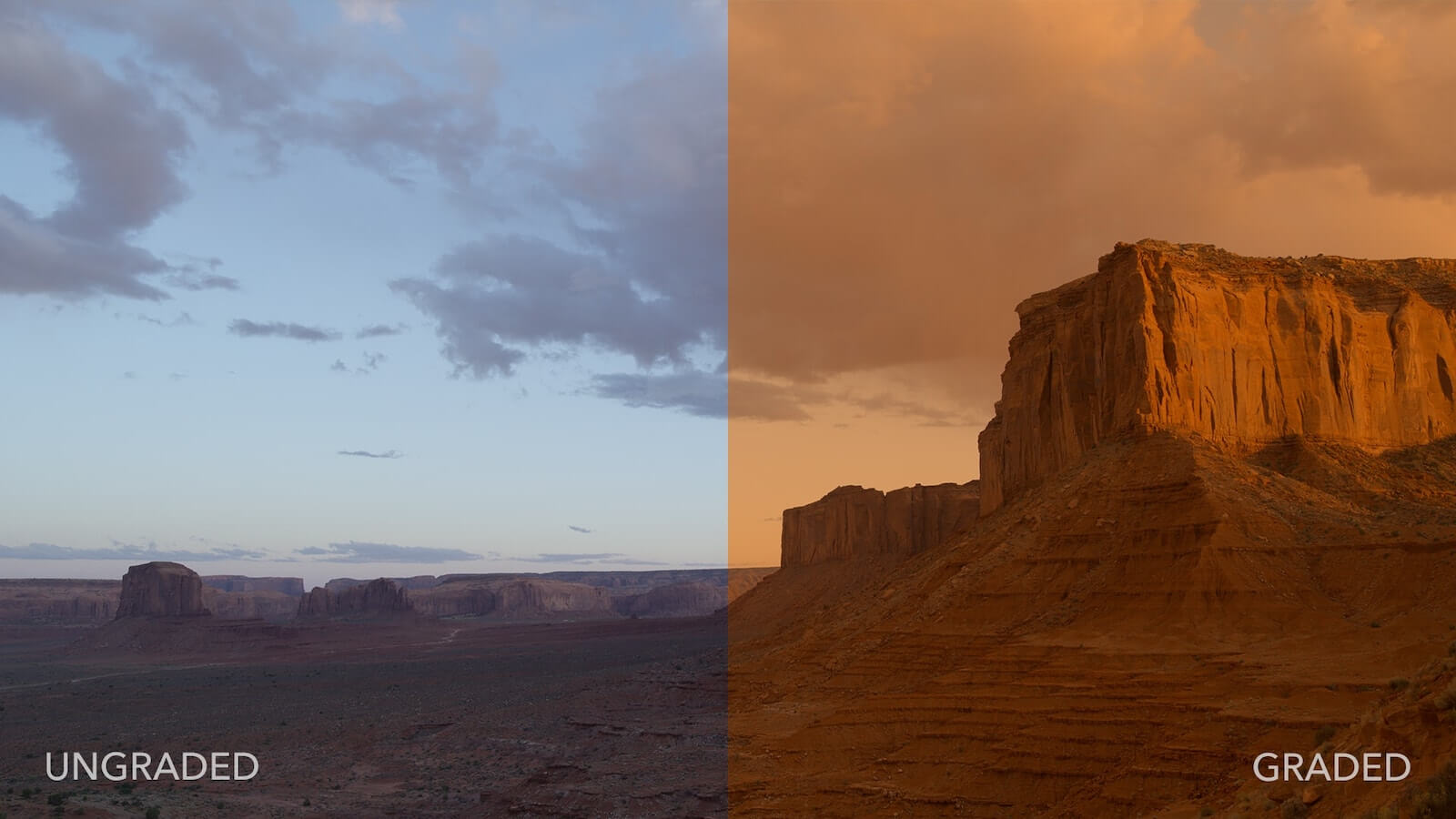
Color grading examples from The Martian
The sky in this prune has completely lost its blue, and become dark-brown, but man exercise those reds and oranges come out. You'd almost remember the lack of color contrast would injure, only it doesn't.
For these 2 examples, we used the free Ridley Scott LUT pack.
Go along in mind: if these clips had non been properly colour corrected first, the LUTs wouldn't have worked this way.
3.4 VIDEO COLOR EXAMPLES
Color Palette Examples
Here are some examples of colour palettes from pop films and tv. Keep an eye out for colors that have the same hues but unlike saturation and effulgence. Check out Kukrosawa:
Create a colour palette similar Akira Kurosawa
Color is one of the more than complicated portions of picture and video because it requires a coherent plan from the starting time.
Performances tin exist hashed out by the director and actors.
Lighting tin can be figured out by the DP and gaffer.
Audio can be taken care of by the audio team.
But for color to be done correctly, you need good lighting, good production blueprint, thoughtful input from the director, and plain a skilled colorist.
And now you know a skilled colorist who has done their research: you!
Upwards Side by side
Color in Film: 50+ Examples
Now that you're ready to colour and edit your footage, make sure to check out our postal service on how to use color in motion-picture show where we provide you lot with a costless e-book to help you color your footage during every phase of production. If you're about to color correct and grade some footage, why not use this guide to inspire some big decisions that will brand your clients and viewers understand why they come to you - great imagery.
Upwardly Next: How to Utilise Color in Picture show →

Create product calendars with a drag-and-drop timeline
Create customizable production calendars for your next video or photoshoot. Add events, tasks, and dependencies. Invite your team and share calendars with clients.
Learn More ➜

wilsonartilegive96.blogspot.com
Source: https://www.studiobinder.com/blog/color-grading-vs-color-correction-process/
0 Response to "Lyndacom the Art of Color Correction Color Grading for Locations and Times of Day"
Post a Comment